
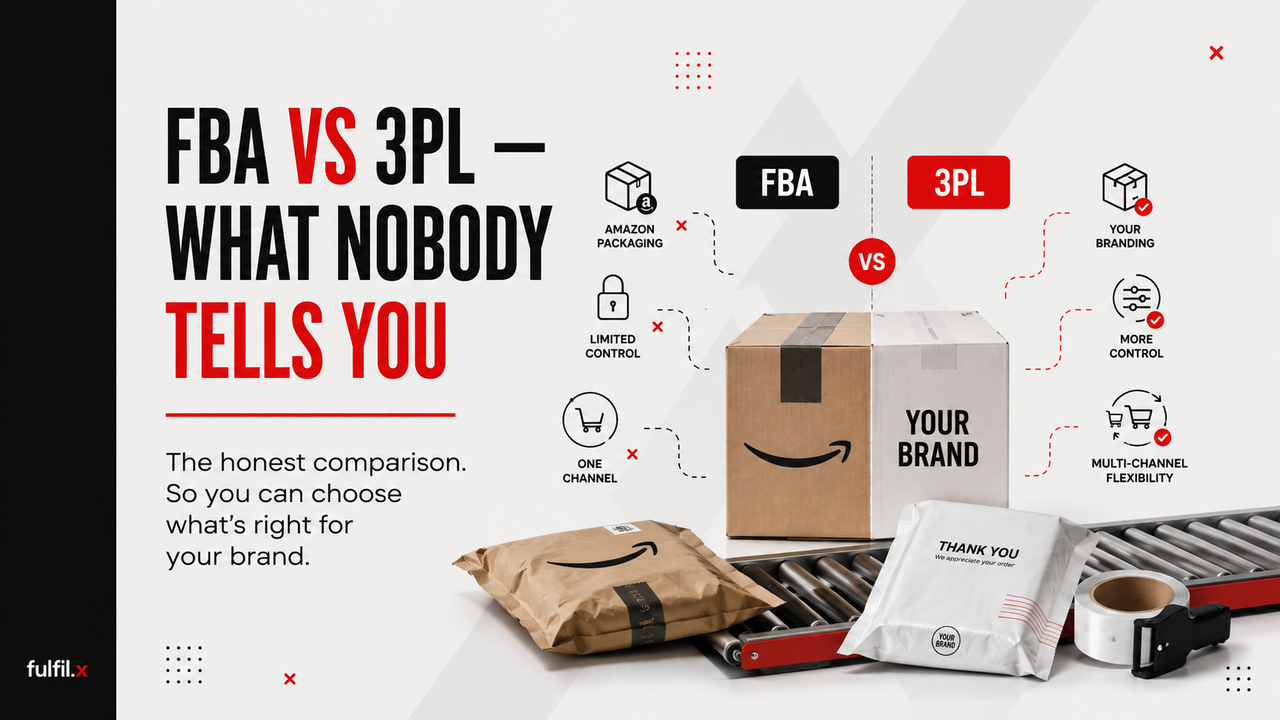
If you're selling on Amazon, you've probably considered Fulfilment by Amazon. It's convenient, well-known and for many brands, it seems like the obvious choice.
But FBA isn't the right solution for every business. As brands grow, expand across multiple channels and become more focused on their customer experience, its limitations can become harder to ignore. So what's the real difference between FBA and a 3PL — and which is right for your brand?
What Is FBA?
Fulfilment by Amazon, or FBA, is Amazon's own fulfilment service. You send your stock to Amazon's fulfilment centres and they handle the picking, packing and dispatch of orders placed through Amazon. It also gives eligible products access to Prime and takes care of fulfilment-related customer service and returns.
For brands selling primarily through Amazon, this can be a simple and effective solution.But as your business grows, you may need more control than FBA is designed to provide.
What Is a 3PL?
A third-party logistics provider, or 3PL, is an independent fulfilment partner that manages your stock, picking, packing and dispatch on your behalf. The biggest difference is flexibility. A 3PL isn't tied to one marketplace, meaning orders from Shopify, Amazon, TikTok Shop, eBay, Etsy and other channels can all be managed through the same fulfilment operation.
For growing e-commerce brands, that can make a significant difference.
Where FBA Can Fall Short
Your Brand Experience
One of the biggest limitations for brand-focused businesses is control over the customer experience. When Amazon fulfils an order, it arrives through Amazon's fulfilment network and packaging.
If your brand relies on branded packaging, personalised inserts or a carefully designed unboxing experience, that can be restrictive. A 3PL can replicate your specific requirements across every order, helping the delivery experience feel like an extension of your brand rather than simply another Amazon delivery.
Multiple Sales Channels
Most growing e-commerce brands don't stay on one channel forever. You might start with Amazon, launch a Shopify store, add TikTok Shop and eventually expand onto other marketplaces.
FBA only solves the fulfilment side of your Amazon orders. The rest of your channels still need somewhere to store stock and process orders. A 3PL can bring those channels together under one operation, giving you one inventory pool and one fulfilment partner rather than several separate processes.
The True Cost
FBA costs can be more complicated than they initially appear. Alongside fulfilment and storage fees, brands may also need to consider charges around long-term storage, returns, removals, aged inventory and other aspects of the service.
That doesn't automatically make FBA more expensive. But it does mean you need to look at the total cost of fulfilment, rather than just the headline fee.
Customer Relationships
When a customer buys through Amazon, Amazon owns much of that customer relationship. For brands focused on building a direct customer base, encouraging repeat purchases and creating a community around the brand, that can be an important consideration.
A 3PL gives you the infrastructure to fulfil direct-to-consumer orders while maintaining your own customer relationship.
Where FBA Makes Sense
It's important to be fair: FBA isn't a bad fulfilment solution. For brands that primarily sell through Amazon, it offers some major advantages.
Prime eligibility is a particularly important one, while Amazon also takes care of much of the fulfilment process and related customer service. If Amazon is your only sales channel and you're happy operating within its ecosystem, FBA can be a very practical option.
The question isn't whether FBA is good or bad.
It's whether it's right for the business you're building.
What About Using Both? You don't necessarily have to choose one or the other.
Some brands use FBA for their Amazon orders while working with a 3PL to fulfil Shopify, TikTok Shop and other direct orders.
This can work well when Prime eligibility is important, but it can also mean splitting inventory between different locations and managing more than one fulfilment process. For other brands, bringing everything under one 3PL makes more sense.
It ultimately comes down to your sales channels, your priorities and where you want the business to go next.
The Bigger Question: What Are You Building?
The FBA vs 3PL decision isn't simply about storage fees or fulfilment costs. It's about the kind of business you want to build. FBA is designed around selling through Amazon. It's convenient, established and effective within that ecosystem.
A 3PL gives you greater flexibility to build across multiple channels, maintain a consistent customer experience and have more control over how your orders are fulfilled. If your ambition is to build a brand that exists beyond Amazon, that distinction matters.
What FULFIL.X Offers
At FULFIL.X, we work with e-commerce startups and scaling brands across the UK that want a fulfilment partner supporting every channel they sell through — not just one.
We offer same-day dispatch, 99.94% accuracy, real-time stock visibility and bespoke fulfilment tailored to your requirements, including branded packaging, personalised inserts, kitting and specific presentation requirements.
Whether you're considering moving away from FBA, looking to centralise your fulfilment or deciding whether to use FBA alongside a 3PL, the right answer depends on your business.
The important thing is choosing a fulfilment setup that supports where your brand is going — not just where it is today.