
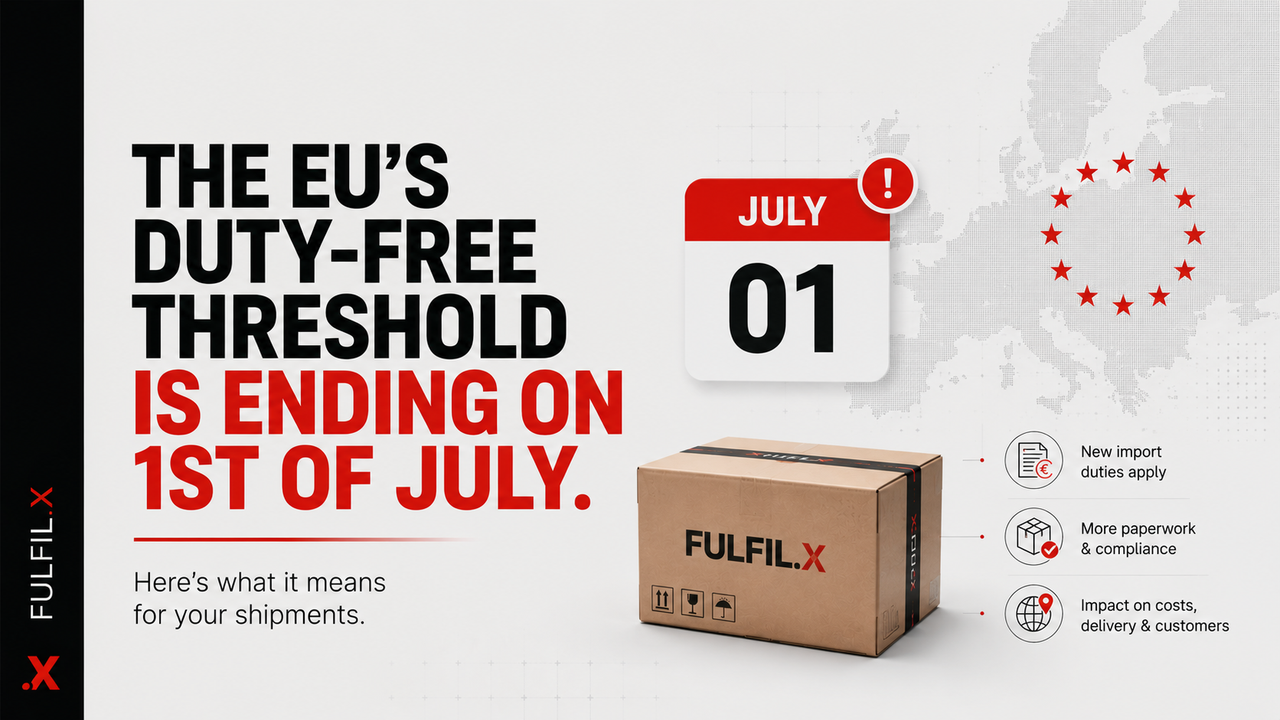
The EU's Duty-Free Threshold Is Ending on 1 July. Here's What It Means For Your Shipments
If you sell into the EU, this one's worth pinning to the top of your inbox.
From 1 July 2026, the EU is removing the long-standing rule that let parcels under €150 enter duty-free. In its place, a flat €3 customs duty applies to low-value consignments and it sits alongside VAT rather than replacing it. The change is locked in under EU law, it's already live in some member states in different forms and it touches every UK brand shipping to EU customers, not just the big orders.
Here's what's actually changing, who pays it and how to get ahead of it before the deadline hits.
What's changing
For over a decade, parcels valued at €150 or less moved into the EU without attracting customs duty. VAT still applied, but duty didn't. That exemption disappears on 1 July 2026.
In its place:
A temporary flat duty of €3 per item, based on tariff classification, applies to qualifying low-value consignments.
This runs until 1 July 2028, when the EU moves to a full tariff-based system with duty rates set by product type and country of origin.
A separate EU-wide handling fee (expected to be in the region of €2 to €3) is being discussed for later in 2026, on top of the €3 duty. It's not yet confirmed.
This is a new charge on top of VAT. IOSS already handles VAT collection, but it doesn't cover this duty. The two are separate obligations.
A few EU countries haven't waited for the EU-wide rollout. France introduced its own per-item charge earlier this year and Romania has had something similar in place since January. The direction of travel has been clear for a while, the EU-wide change just makes it official everywhere at once.
Who actually pays it
This is the part that trips brands up. The €3 duty isn't collected from the customer at the door the way some older customs charges were. It's owed by the declarant, which in most cases is whoever holds the IOSS registration for the sale, meaning the seller, or the seller's IOSS intermediary.
If you're registered for IOSS, you (or your representative) are now on the hook for this duty as well as VAT. If you're not on IOSS at all, you're not automatically exempt either, so it's worth checking exactly how your current setup handles it.
Why "per item" matters more than it sounds
The €3 charge applies per tariff classification (HS code), not per parcel. That distinction has real margin implications.
Say you ship a gift set with a serum and a moisturiser and they sit under two different HS codes. That's two charges, not one. A box with five units of the same product under one HS code is still just one charge. The brands who'll feel this least are the ones who've already mapped their SKUs to the right HS codes and know exactly what's in each parcel from a customs perspective. The brands who'll feel it most are the ones still treating HS codes as a box-ticking exercise.
What to do before 1 July
A short list, but worth working through properly:
Confirm your IOSS setup. Check whether your IOSS registration or intermediary already accounts for this duty, or whether that's a separate conversation you need to have.
Audit your HS codes. Make sure every SKU is mapped correctly. Multi-item parcels with mixed classifications are where costs add up fastest.
Decide your pricing approach. Absorb the cost, pass it on, or split the difference. There's no universally right answer here, it depends on your margins and your price sensitivity by market.
Check what your checkout actually shows. If you're on Shopify, your customers should be seeing accurate landed cost (VAT and duty) at checkout, not finding out about extra charges after the parcel's already left the warehouse.
Talk to your fulfilment partner about how this gets handled operationally, not just administratively. Someone has to actually manage the declarations on every parcel, every day.
How we're handling this for our clients
We're talking clients through how to get IOSS set up directly in their Shopify checkout, so duty and VAT are calculated and shown upfront, rather than surprising the customer after the parcel's already left the warehouse. Done right, that means no surprise charges, no parcels stuck at customs, and no support tickets from confused buyers in Germany or the Netherlands.
For brands who aren't on IOSS, or who want a different structure depending on volume and markets, we also run a non-IOSS shipping route as an alternative. Which setup makes sense depends on your order values, your EU sales mix and how much of this you want visible to the customer versus handled in the background.
If you haven't reviewed your EU shipping setup against this change yet, now's the time. Get in touch and we'll walk through what it looks like for your specific SKUs and order profile before 1 July arrives.