
When you're choosing a fulfilment partner, it's easy to focus on the numbers.
How much is storage? What's the pick and pack fee? How much will shipping cost per order? Those things matter, but they don't tell the whole story. The real cost of fulfilment often appears when things don't go to plan.
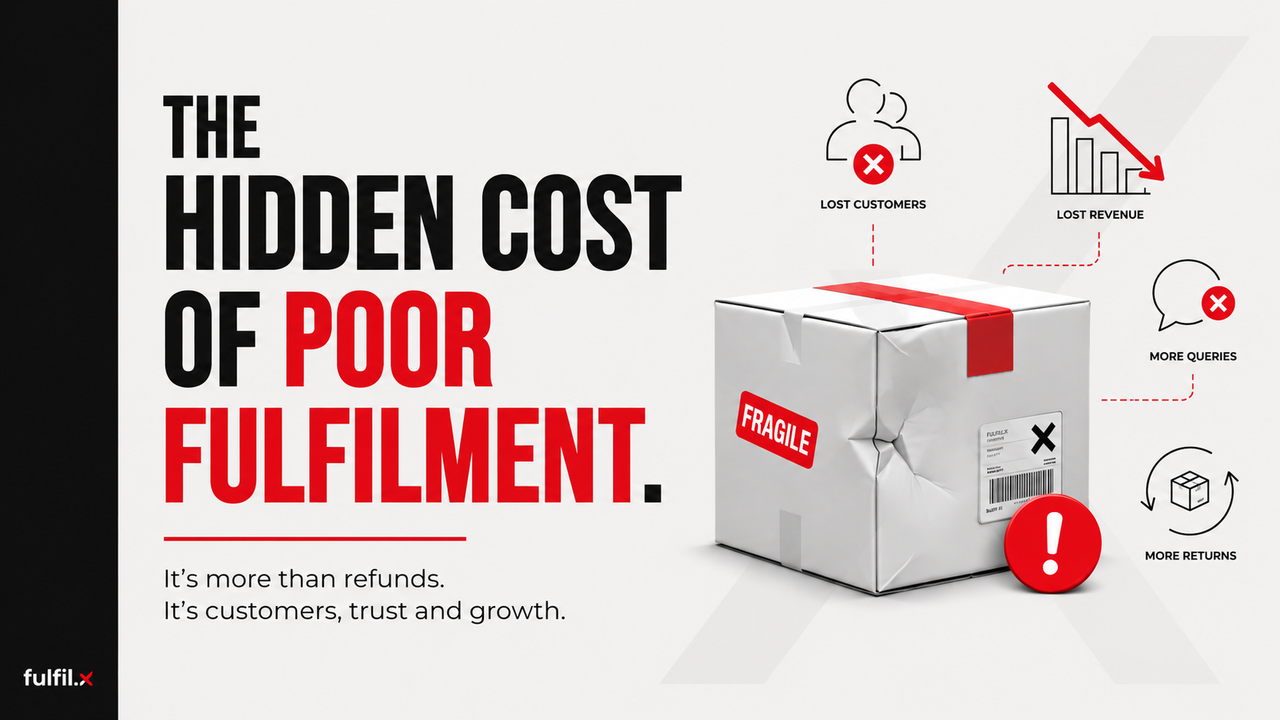
A missed dispatch can lead to a customer complaint. A picking error can mean a replacement order. Poor communication can leave your customer service team chasing answers. If those problems happen often enough, they can start to affect something far more valuable than your fulfilment budget: your customers.
-
The Fulfilment Problem Doesn't Stay in the Warehouse
It's easy to think of a fulfilment error as a warehouse problem. A product wasn't picked correctly. An order wasn't dispatched. A parcel was sent to the wrong address.
Problem solved, right? Not quite.
The moment that order reaches your customer, the problem becomes yours too. Your customer contacts your support team. Someone now has to investigate what happened, contact the fulfilment provider, find the missing information and work out how to resolve it.
If the wrong item was sent, there might be a replacement to arrange. If an order was missed, you might need to pay for expedited shipping. If something is damaged, you could be dealing with a return and a refund.
A fulfilment problem rarely stays a fulfilment problem.
-
The Cost of Poor Communication
One of the biggest frustrations for growing e-commerce brands isn't necessarily that something has gone wrong. It's not knowing what's happened or when it's going to be fixed. When you're running a business, you need answers quickly.
Where is the order? Has it been picked? Why hasn't it dispatched? How much stock do we actually have? Has that return arrived?
If getting an answer means sending an email, waiting, following up and then waiting again, your team ends up spending valuable time managing the fulfilment provider rather than managing the business. This is one of the recurring frustrations highlighted in the FULFIL.X source material: growing brands can find themselves feeling deprioritised by larger fulfilment operations, particularly when communication becomes slow or inconsistent.
Outsourcing fulfilment should reduce the amount of operational work on your plate. It shouldn't simply move the work from packing boxes to chasing someone who packs the boxes.
-
When Outsourcing Doesn't Actually Feel Like Outsourcing
This is where the difference between a fulfilment provider and a true fulfilment partner becomes important. The whole reason many businesses move to a 3PL is to create more time and capacity. You shouldn't have to spend your day checking whether orders have left the warehouse, investigating stock discrepancies or repeatedly asking for updates.
When that happens, you're still managing the fulfilment operation you're just not physically standing in the warehouse. The operation has scaled, but the problems have scaled with it.
-
The Customer Sees Your Brand, Not Your Warehouse
Customer cost is much harder to put on a spreadsheet. Your customer doesn't know who picked their order. They don't know which warehouse management system you're using or whether your 3PL had a particularly busy morning. They bought from your brand.
So when an order arrives late, damaged or incorrect, their experience is still an experience of your business.
The FULFIL.X research specifically identifies customers leaving because of poor delivery experiences as one of the key pain points for e-commerce brands. And that's where a single fulfilment issue can become much more expensive. A customer who would have bought from you again may decide that the experience wasn't worth repeating.
-
The Hidden Cost of Fixing Mistakes
It's also important to look beyond the original fulfilment charge. Imagine an order is picked incorrectly. You may now have the original fulfilment cost, the cost of sending the replacement, the cost of processing the return, the replacement product, the time your customer service team spends resolving the issue and potentially the cost of a refund or discount to keep the customer happy. None of those costs necessarily appear under your standard pick and pack fee but they're still costs created by the fulfilment process.
-
So, What Should Good Fulfilment Actually Look Like?
Good fulfilment should be something you can rely on rather than something you constantly have to manage. That means accurate picking, reliable dispatch, clear stock visibility, efficient returns, good technology and fast communication. Also, a team that understands that when something goes wrong, it needs to be dealt with quickly.
The goal isn't to pretend that nothing will ever go wrong. Things happen.
The difference is what happens when they do.
Can you get an answer quickly? Can the issue be identified? Can it be resolved? And can the same problem be prevented from happening again?
That's what separates a fulfilment operation that simply processes orders from one that actually supports a growing business.
-
Where FULFIL.X Fits In
This is exactly why FULFIL.X has focused on building more than just a place to store and ship products. The operation has been designed around the areas that can create the most friction for growing e-commerce brands: speed, accuracy, visibility and communication.
FULFIL.X has a 2-minute response time, so when something needs attention, you're not left waiting days for an answer.
Its warehouse management system provides real-time visibility into stock and orders, while a 99.94% pick accuracy helps reduce the errors that can lead to replacements, refunds and customer service issues. There is also a 2pm same-day dispatch cut-off, helping orders move through the operation quickly rather than sitting until the following day.
And because FULFIL.X works with multiple e-commerce platforms and courier partners, the fulfilment operation can adapt around how a brand actually sells rather than forcing the brand to change the way it operates. The aim isn't simply to fulfil an order. It's to make the whole process easier to manage, easier to understand and easier to scale.