
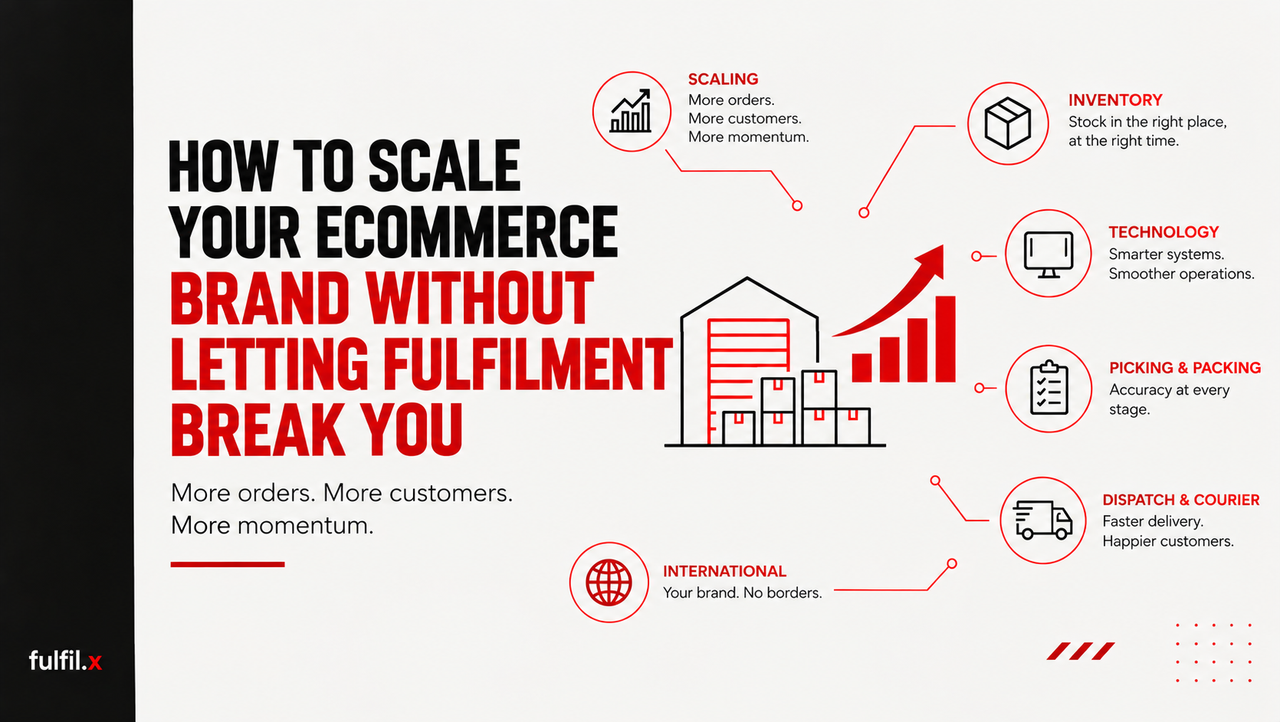
Scaling an ecommerce brand is supposed to feel like winning. More orders, more revenue, more momentum — proof that what you've built is working.
But for many founders, scaling can feel more like drowning.
Orders arrive faster than you can process them. Dispatch starts slipping. Errors increase. Customer complaints follow. Suddenly, the operation that worked perfectly at 50 orders a day is struggling to cope with 500.
The problem isn't necessarily growth. It's that your fulfilment infrastructure hasn't grown with you.
Here's how to scale without letting fulfilment become the thing that holds your business back.
Why Fulfilment Breaks First
Every part of a growing e-commerce business comes under pressure such as marketing, customer service, sourcing and cash flow.
But fulfilment is often where the cracks become most visible because it directly affects the customer experience.
Early stage brands tend to build their operation around what works at a lower volume: manual processes, limited space and simple systems. That's perfectly reasonable at 50 orders a day.
The problem is that fulfilment doesn't scale linearly.
Doing the same processes faster, or simply adding more people, won't necessarily solve the problem. At higher volumes, the operation itself needs to change.
The brands that scale successfully recognise this before they're in crisis.
The Warning Signs
There are a few clear signs that your fulfilment operation is starting to struggle:
Dispatch times are slipping. Same day dispatch becomes next day, then longer, as volume exceeds what your operation can reliably process.
Errors are increasing. Wrong items, missing products and incorrect quantities create extra work, replacement costs and unhappy customers.
Customer complaints are rising. Late or incorrect orders turn customer service from a manageable function into a constant firefighting exercise.
Stock visibility is deteriorating. As stock moves faster, manual tracking becomes unreliable, increasing the risk of overselling, stock outs and dead inventory.
Your team is overwhelmed. Even a great team has a limit. When the operation isn't built for the volume, stress and mistakes increase.
And perhaps the biggest warning sign:
You're spending more time managing fulfilment than growing the business.
When growth starts feeling like a punishment rather than a reward, something needs to change.
The Mistakes Growing Brands Make
Hiring More People to Fix an Infrastructure Problem
Adding staff can help with capacity, but it won't fix inefficient processes.
If you're relying on manual picking or spreadsheets for stock management, adding more people simply means more people working within the same limitations.
People are part of a strong fulfilment operation — but they need the right systems and processes around them.
Waiting Too Long to Invest in Technology
A proper WMS, e-commerce integrations and real time inventory tracking can feel like significant investments.
But the cost of not having them can be much higher: fulfilment errors, lost customers, negative reviews and valuable time spent firefighting.
The goal isn't to invest when you're already in crisis. It's to build the infrastructure before you need it.
Scaling Marketing Faster Than Operations
One of the most painful scenarios is simple: a campaign works extremely well, orders flood in and fulfilment can't keep up.
The marketing investment has generated customers — but the operation isn't ready to serve them.
Marketing and operations need to scale together. There's little value in acquiring customers faster than you can fulfil their orders properly.
How to Build Fulfilment That Scales
Build the right infrastructure early.
That means proper warehouse management technology, direct e-commerce integrations, documented processes and physical capacity that can grow with you.
Build visibility into everything.
Real time visibility over inventory, order accuracy, dispatch performance and returns allows you to identify problems before they become crises.
Plan for peaks.
Black Friday, Christmas, product launches and viral moments can all create sudden increases in demand. Carrier capacity, staffing, stock and processes need to be prepared before the pressure arrives.
Consider outsourcing before you're desperate.
Many brands wait until their internal operation is already struggling before considering a 3PL.
Moving earlier gives you time to properly assess providers, onboard effectively and build an operation designed around where your business is going — rather than trying to fix one that's already breaking.
When choosing a fulfilment partner, ask how they handle volume spikes, what technology they use, how they manage carrier capacity and what volumes they've successfully handled before.
The right partner should already have solved the scaling problems you're about to encounter.
What Scaling Looks Like When Fulfilment Is Right
When your fulfilment infrastructure is built for scale, growth feels different.
Orders increase without accuracy falling. Dispatch stays consistent. Stock remains visible. Customer complaints don't suddenly spike because volume has increased.
And most importantly, the founder isn't spending their time firefighting operational problems.
They're building the business.
That's the difference between scaling and struggling.
Your fulfilment operation shouldn't just support where your brand is today. It should be ready for where you're going next.
How FULFIL.X Supports Scaling Brands
At FULFIL.X, we work with e-commerce brands that are growing and need fulfilment that can keep pace.
Our WMS supports consistent accuracy at scale, with an accuracy rate that has never dropped below 99.94%, regardless of order volume. Same day dispatch is our standard, while real-time stock visibility gives brands a clear view of their inventory.
Our infrastructure, carrier relationships and staffing are designed to handle the volume spikes that come with serious growth.
We also offer bespoke fulfilment for brands that don't want to compromise their customer experience as they scale — from branded packaging and personalised inserts to kitting and specific presentation requirements.
If your current fulfilment operation is starting to feel the strain, now is the time to address it. Before it becomes a challenge.
We offer a free fulfilment health check to give you an honest picture of where your operation stands and what needs to change to support your next stage of growth.