
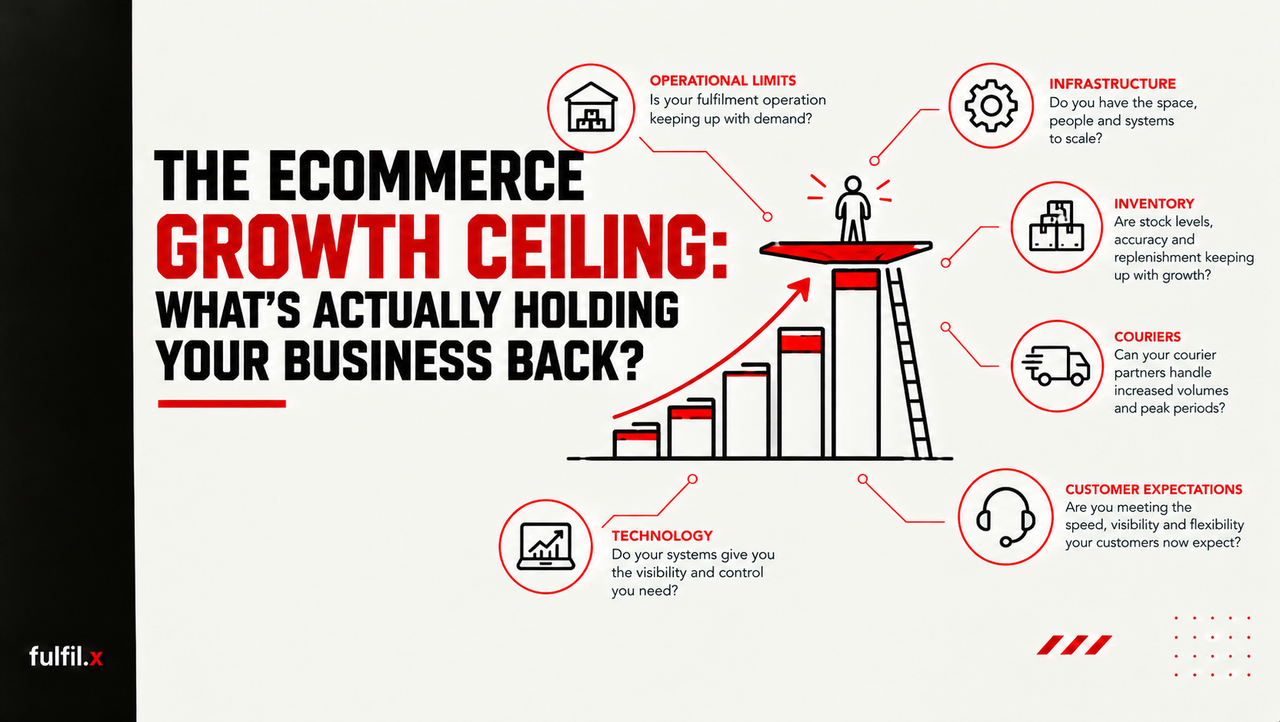
Growing an e-commerce business is exciting. More orders, new customers and increasing sales are all signs that things are moving in the right direction.
But growth doesn't always come without complications. As order volumes increase, the processes that once worked perfectly well can start to show their limitations.
What used to take a few hours might now take an entire day. Stock becomes harder to manage, customer enquiries increase and fulfilment starts taking up more time than the business itself.
At some point, growth can begin to feel less like progress and more like pressure.
So, what's actually holding your e-commerce business back?
When Your Operations Can't Keep Up
One of the biggest challenges for growing e-commerce brands is having operational processes that haven't developed at the same pace as sales.
A fulfilment setup that works for 20 orders a day might struggle with 200. Manual stock updates, limited storage space and time-consuming picking and packing processes can quickly become inefficient as demand increases.
The problem isn't necessarily that the business is growing too quickly. It's that the infrastructure supporting it hasn't grown alongside it.
Recognising when existing processes are becoming a bottleneck is an important step towards building an operation that can support further growth.
The Hidden Pressure of Inventory Management
As a product range expands, keeping track of inventory becomes increasingly complicated.
More products mean more SKUs, additional storage requirements and a greater risk of stock discrepancies. If inventory isn't accurately monitored, businesses can find themselves overselling products, missing replenishment opportunities or tying up money in stock that isn't moving.
This can become even more challenging when selling across multiple platforms. Keeping stock levels consistent between Shopify, Amazon, TikTok Shop and other sales channels requires reliable systems and accurate inventory information.
Having clear visibility over stock helps businesses make better purchasing decisions, manage demand and avoid unnecessary disruption.
When Time Becomes the Biggest Bottleneck
For many growing brands, time is one of their most valuable resources.
As order volumes increase, more time is spent managing deliveries, organising stock, packing orders and dealing with operational issues. Tasks that were once manageable can start taking attention away from marketing, product development and business strategy.
The result is that founders can end up spending more time keeping the business running than actually growing it.
This is often a sign that certain processes need reviewing. Improving efficiency, introducing better systems or outsourcing parts of the operation can help free up time and allow business owners to focus on the areas that drive growth.
Are Your Systems Built for What's Next?
Technology plays an important role in supporting e-commerce growth.
When businesses first start out, spreadsheets and manual processes might be enough to manage orders and stock. However, as operations become more complex, these methods can become difficult to maintain.
A reliable warehouse management system (WMS), integrated sales channels and accurate reporting can help improve visibility across the entire fulfilment process.
Having the right technology in place isn't just about making day-to-day operations easier. It's about creating a foundation that can support higher order volumes, additional sales channels and future expansion.
Knowing When to Make a Change
There isn't one specific point at which every e-commerce business needs additional support. It depends on order volumes, product ranges, available resources and future ambitions.
For some brands, improving their existing processes is enough. For others, limited warehouse space, increasing labour requirements and fulfilment pressures can make it difficult to continue scaling independently.
Working with a third-party logistics provider (3PL) can offer access to warehouse space, established fulfilment processes, technology and operational support without having to manage every element in-house.
The important thing is to understand what your business needs now, as well as what it might need in the future.
Don't Let Your Operations Limit Your Growth
Reaching the next stage of e-commerce growth isn't simply about generating more sales. It's about making sure the business behind those sales is ready to support them.
If fulfilment is taking up too much time, inventory is becoming harder to manage or your current setup is struggling with increasing demand, it could be time to review your operation.
Growth should create new opportunities, not introduce limitations.
The goal isn't just to grow your business. It's to build an operation that can grow with it.