
When you're choosing a 3PL, there’s one question that doesn’t get asked nearly often enough.
What system are you actually running the warehouse on?
It might not sound like the most exciting question, but the answer can tell you a lot about the quality of the operation behind your fulfilment.
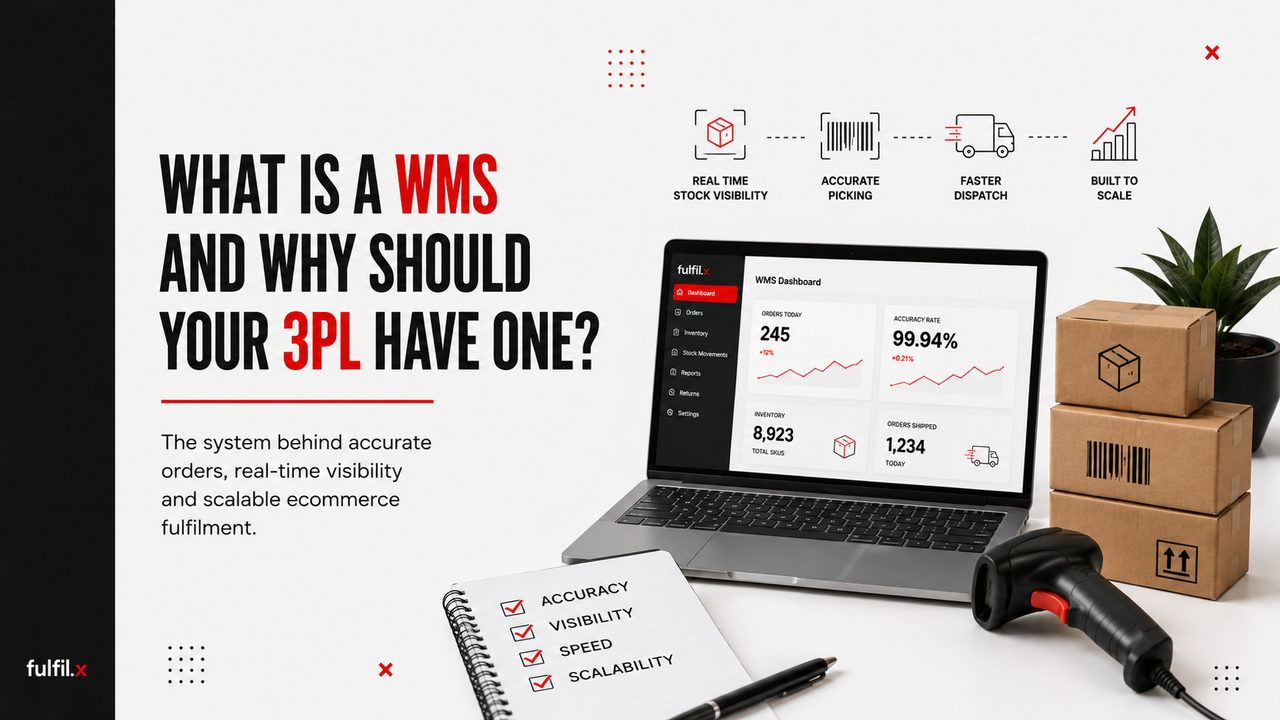
A proper Warehouse Management System (WMS) has a direct impact on how accurately your orders are picked, how quickly they are dispatched, how much visibility you have over your stock and how confidently you can make decisions as your business grows.
What Does a WMS Actually Do?
WMS stands for Warehouse Management System. Put simply, it’s the software that runs the warehouse.
It tracks stock from the moment it arrives through to the moment it leaves in a parcel heading to your customer. A good WMS manages everything from receiving stock and assigning storage locations to processing e-commerce orders, directing warehouse staff, verifying picks, managing dispatch and keeping inventory records up to date in real time.
The important part is that these processes are connected. Instead of relying on someone remembering where an item is stored or manually updating a spreadsheet when stock moves, every action is recorded and tracked by the system. That means fewer opportunities for things to go wrong.
What Happens When a Customer Places an Order?
The easiest way to understand the value of a WMS is to look at what happens behind the scenes when someone places an order. A customer places an order through your Shopify store. The order is automatically sent into the WMS through the ecommerce integration, without someone having to manually enter the details.
The system then tells the warehouse team exactly where the products are located and what needs to be picked. When the item is picked, its barcode is scanned. The WMS checks that the correct product, variant and quantity have been selected. If something doesn't match, the system flags it before the order can continue.
The order is then packed according to the requirements of the brand, the dispatch label is generated and the stock is automatically updated. From the customer's perspective, it’s simply an order arriving correctly and on time. Behind the scenes, there’s a system making sure every part of the process connects.
Why Does This Matter for Your Brand?
The first — and probably most obvious — benefit is accuracy. Barcode verification helps prevent the wrong product, size or variant from making its way to your customer.
At FULFIL.X, our accuracy rate has never dropped below 99.94%. That level of consistency is only achievable when the right technology, processes and people are working together.
Then there’s stock visibility.
With a proper WMS, every movement of stock is recorded in real time. You can see what you have, what has been picked, what has been dispatched and what is coming back through returns.
For a growing e-commerce brand, that visibility is hugely valuable. You don't want to discover that your best-selling product has sold out because your stock records weren't accurate. Equally, you don't want to keep ordering inventory that you already have sitting in the warehouse.
A WMS gives you a much clearer picture of what's actually happening with your stock. It also makes the operation faster and easier to scale. The system can optimise picking routes, batch orders and reduce unnecessary movement around the warehouse. That becomes increasingly important as your order volume grows.
An operation that works reasonably well at 100 orders a day can look very different at 1,000. A proper WMS allows the underlying process to scale without relying on more spreadsheets, more manual checks or people simply working harder.
What Happens Without One?
This is where things become particularly important when you're comparing 3PLs. Without a proper WMS, warehouses may rely heavily on spreadsheets, printed pick lists and manual processes.
Stock movements may need to be updated manually. Warehouse staff may rely on memory to locate products. Orders may be checked by hand rather than through barcode verification. At low volumes, this might appear to work. But as your business grows, the weaknesses become much more obvious, errors increase. Stock records become harder to trust and processing slows down. Busy periods become more difficult to manage, and problems are often discovered when a customer complains rather than before the order leaves the warehouse.
For an e-commerce brand, those aren't simply warehouse problems. They can become customer experience and reputation problems.
The Questions to Ask Your 3PL
You don't need to be a logistics expert to assess whether a 3PL has the right technology. Ask them what WMS they use.
Ask to see their client portal and find out whether you can access real-time stock and order information.
Ask how orders move from your e-commerce platform into their warehouse system.
Ask how they verify picks and what happens when a barcode doesn't match an order.
And most importantly, ask what fulfilment data they can actually share with you.
A good 3PL should be able to answer these questions clearly.
At FULFIL.X, our WMS sits at the centre of our fulfilment operation. Every order is processed through the system, every pick is barcode-verified and clients have real-time visibility of their stock and order history.
It’s one of the reasons we've maintained an accuracy rate of 99.94% and can offer same-day dispatch as a consistent standard. Because your 3PL's technology isn't just a technical detail. It directly affects the experience your customers receive.